

The pace of information movement in the public sphere is extraordinarily fast. A shift in public opinion on social media can quickly escalate into a national reputation crisis in just a matter of hours. For government agencies, Badan Usaha Milik Negara (BUMN), and large-scale corporations, handling this dynamic requires a media intelligence system that not only reads the situation but also guides mitigation actions to completion.
To provide comprehensive protection for organizational information resilience, PT Artha Solusi Indonesia developed the NIRES (National Information Resilience Enhancement System) platform. It contains several modules, and we will discuss the three core modules that work continuously to transform raw data into actionable steps: Trend & Escalation Assessment, Strategic Response Advisor, and Response Task Management.
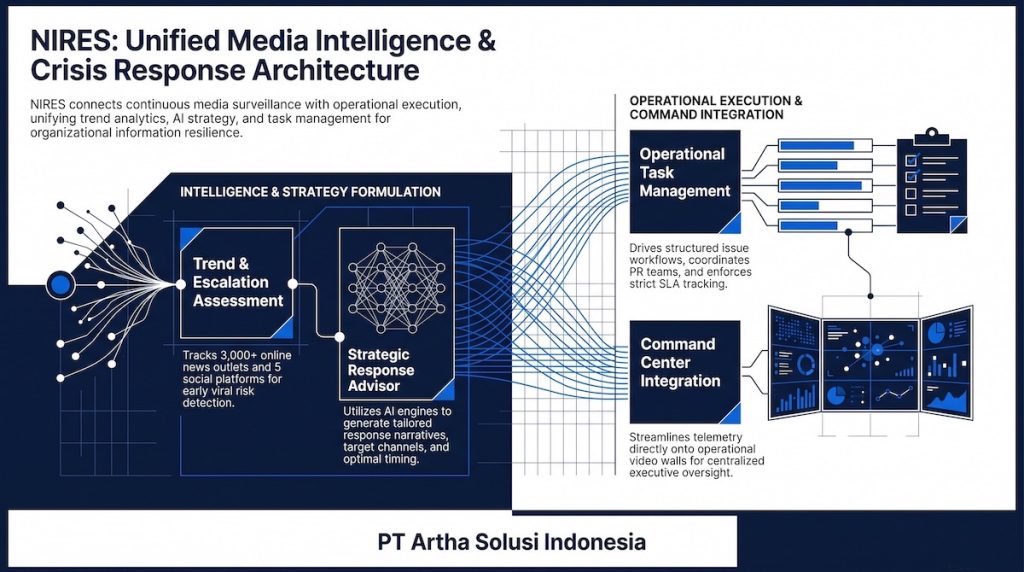 Here is an in-depth guide on how these three modules seamlessly connect to form an integrated reputation defense.
1. Detection Stage: Trend & Escalation Assessment Module
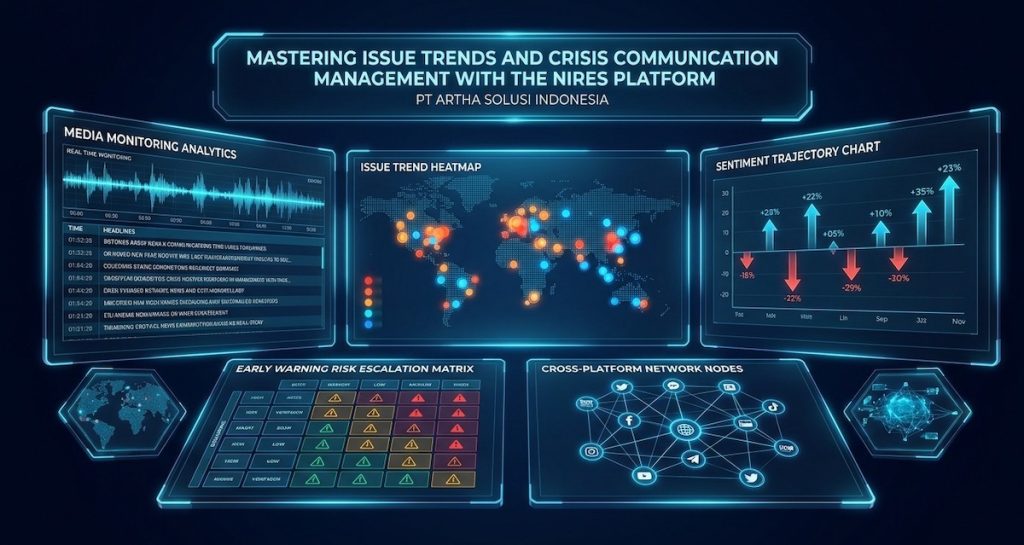
The first step in maintaining information resilience is the ability to read field dynamics before a crisis erupts. The Trend & Escalation Assessment module acts as a 24/7 monitoring radar that scans over 3,000 online news portals and 5 major social media platforms. This module integrates crucial monitoring functions:
-
Issue Trend Analysis in Real-Time: Identifies public conversation patterns, trending topics, and measures the Net Sentiment Score to understand the direction of public perception.
-
Viral Issue Detection Early On: Uses Natural Language Processing (NLP) algorithms to find anomalous spikes in conversation volume. The system can distinguish between organic conversations and opinion manipulation driven by bot networks.
-
Issue Early Warning and Risk Thresholds: When a negative narrative has the potential to grow, this module automatically triggers an issue early warning signal based on risk threshold criteria (escalation matrix) tailored to the organization’s profile.
With this module, analysis teams are no longer drowning in raw data but can focus on issue trends that truly require strategic attention.
2. Formulation Stage: Strategic Response Advisor Module
After potential crises are detected and analyzed by the first module, the next challenge is determining what steps to take. This is where the Strategic Response Advisor module comes in as a bridge between data intelligence and decision-making.
Facing a crisis without clear guiding directions often leads to rushed decisions or counterproductive communication. This module provides solutions through:
-
AI-Driven Issue Response Strategy: Based on the severity of the issue and historical analysis, this module recommends the most effective communication approach options—ranging from official clarifications (holding statements) and persuasive media approaches to Key Opinion Leader (KOL) activation.
-
Crisis Communication Management Narrative Drafting: Helps public relations teams formulate precise key messages to calm public panic and correct disinformation.
-
Channel and Timing Recommendations: Provides guidance on which media channels are most appropriate for delivering responses and determines the best timing momentum so the message is optimally received by the target audience.
3. Execution Stage: Response Task Management Module
A smart response strategy plan will not have an impact without disciplined and coordinated field execution. The Response Task Management module perfects this workflow by converting strategic recommendations into measurable operational actions.
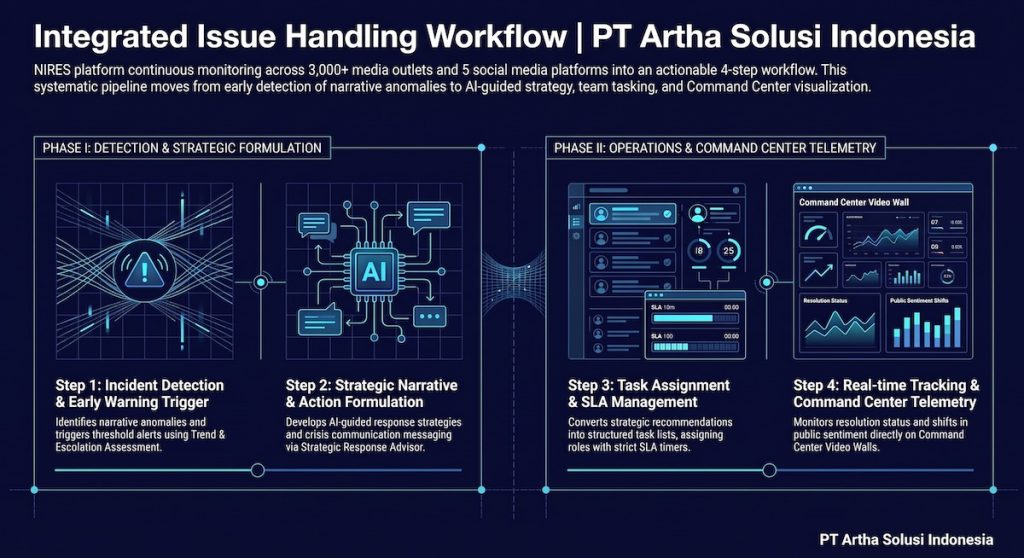
Crises often escalate not due to a lack of planning, but because of slow internal coordination. This module overcomes these obstacles through:
-
Integrated Issue Handling Workflow: Converts recommendations from the Strategic Response Advisor module into structured task lists, complete with Standard Operating Procedures (SOP) and Service Level Agreements (SLA).
-
PR Team Coordination and Inter-Divisional Alignment: Facilitates the transparent distribution of tasks to analysts, spokespersons, social media teams, and executives. Every team member knows their exact roles and responsibilities.
-
Execution Status Tracking and Audit Trail: Presents a real-time response status monitoring dashboard. Leaders can monitor whether official responses have been published, how the public is responding to these actions, and evaluate the effectiveness of crisis management.
Why Choose NIRES by PT Artha Solusi Indonesia?
The synergy of the three modules above makes the NIRES platform by PT Artha Solusi Indonesia the leading media intelligence solution for the B2B and B2G sectors. As an experienced technology integrator in building critical infrastructure and command centers, PT Artha Solusi Indonesia ensures:
-
Command Center Telemetry Integration: All trend indicators, strategy recommendations, and issue handling statuses can be displayed directly on your organization’s Command Center video wall.
-
High Data Security and Compliance: Specifically designed to meet national information security and reliability standards, including government, banking, energy, mining, and manufacturing.
-
Integrated Support (OSINT Enablement): Provides OSINT Enablement services, specific use case development, and continuous training for analyst and public relations teams.
Safeguarding organizational reputation and information resilience cannot be done partially. It is time to shift from passive media monitoring to proactive, precise, and measurable crisis communication management.
By integrating Trend & Escalation Assessment for viral issue detection, Strategic Response Advisor to formulate an issue response strategy, and Response Task Management to oversee the issue handling workflow, the NIRES platform by PT Artha Solusi Indonesia places full control in your hands.
Contact PT Artha Solusi Indonesia for a NIRES Platform demo and consult your organization’s Command Center integration, media monitoring, and crisis communication management needs with our team of experts.