


A netizen’s opinion, a news article, or a customer complaint on digital platforms can change a reputation for the better or plunge it into ruin. The spread of news in the form of public sentiment during this era of digital transformation is incredibly fast; the dynamics of public conversation in cyberspace move in a matter of seconds. As fast as a netizen’s keystrokes, information spreads massively and influences public perception in a short amount of time. Wouldn’t it be better to have digital sentiment assessments so that detrimental issues can be handled immediately?
If government agencies, Badan Usaha Milik Negara (BUMN), financial corporations, or critical infrastructure managers rely solely on conventional media monitoring that merely collects news clippings or measures raw exposure numbers (vanity metrics like the number of likes or views), it is certain that this is no longer sufficient.
Reputation and operational stability within an organization require safeguarding and a much deeper approach: digital sentiment assessment. Through the integration of social media sentiment analysis and open data-based social listening (Open Source Intelligence / OSINT), decision-makers can measure the real impact of publications and identify potential crises before they spread widely.
Understanding the Concepts of Social Listening and Social Media Sentiment Analysis
Fundamentally, digital sentiment assessment is a systematic and continuous evaluation process to measure, analyze, and assess both the qualitative and quantitative impacts of digital narratives on an organization’s reputation and strategic goals. In practice, this methodology rests on two main pillars:
- Social Listening: A proactive and comprehensive monitoring process of public conversations across various social media platforms, discussion forums, blogs, and online news portals. Social listening does not just look at how often an organization’s name is mentioned (brand mentions); it captures the context, trending topics, and the dynamics of shifting public perception.
- Social Media Sentiment Analysis: The use of smart technology based on Artificial Intelligence (AI) and Natural Language Processing (NLP) to classify the emotional tone in public conversations into Positive, Neutral, or Negative categories. With this analysis, organizations can objectively measure their Net Sentiment Score and detect changes in the tone of public conversation in real-time.
The Crucial Importance of Digital Sentiment Assessment for Organizations
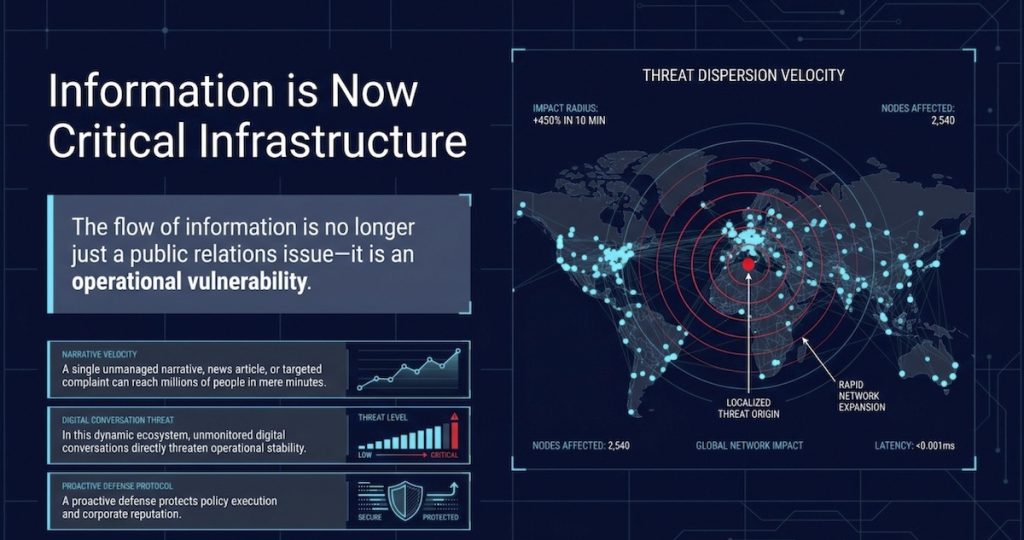
The application of structured social media sentiment analysis and social listening provides both tactical and strategic advantages for executive leaders and communication teams. Here are the three main reasons why digital sentiment assessment has become an urgent need:
- Early Warning System and Crisis Mitigation: Reputation crises rarely happen suddenly; they are usually preceded by an accumulation of undetected negative sentiment. With continuous digital sentiment assessment, organizations can identify ripples of disinformation, hoax campaigns, or spikes in public criticism early on before the issue goes viral and damages their reputation.
- Communication Return on Investment (ROI) Validation: Every public relations campaign, public communication initiative, or policy launch requires concrete proof of its effectiveness. Social listening provides empirical data regarding the extent to which an organization’s key messages (key message pull-through) are actually received, understood, and responded to positively by the target audience.
- Data-Driven Decision Making: Organizational leaders no longer need to make strategic decisions based solely on assumptions or intuition. Digital sentiment impact reports present on-the-ground facts regarding what the public actually feels, allowing for precise adjustments to narratives or policies.
Optimizing Social Listening and Sentiment Analysis with NIRES Technology
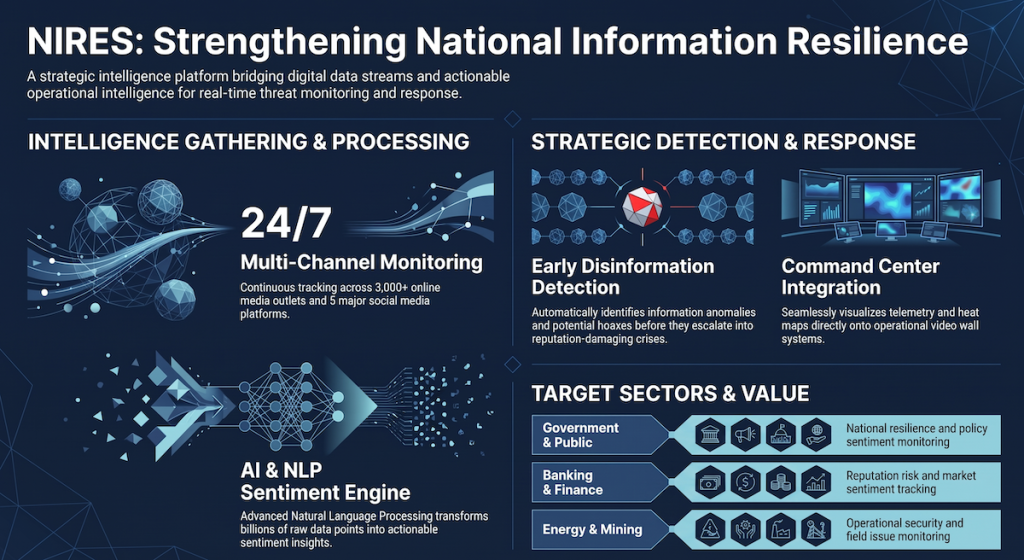
Manually measuring and processing millions of digital conversation data points per day is certainly impossible. Therefore, large-scale organizations need an integrated media intelligence platform like NIRES, developed by PT Artha Solusi Indonesia.
As a technology integrator for critical infrastructure, PT Artha Solusi Indonesia designed NIRES to address the challenges of national information resilience and integrated multi-channel media monitoring:
- Massive Monitoring with No Blind Spots: NIRES monitors over 3,000 online news portals and 5 major social media platforms non-stop 24/7, ensuring no public conversation is missed.
- OSINT Intelligence and Narrative Mapping: Equipped with Open Source Intelligence (OSINT) technology, NIRES automatically processes raw data into a situational map (common operating picture) that displays sentiment graphs, trending topic analysis, and network analysis of issue spreaders.
- Automated Disinformation Prevention: The NIRES algorithm can detect triggers of information anomalies and hoaxes early on, then generate automated notifications to prompt a coordinated cross-team response.
- Executive-Level Visibility in the Command Center: NIRES telemetry and monitoring dashboards are designed to connect directly to video walls in organizational Command Centers, making it easy for leadership to monitor public sentiment conditions directly.
Conducting digital sentiment assessments through comprehensive social media sentiment analysis and social listening is a strategic step to strengthen organizational information resilience. By shifting from mere passive monitoring to intelligence monitoring based on NIRES technology from PT Artha Solusi Indonesia, your organization is not only prepared to anticipate reputation crises but is also equipped to control public narratives in a measurable, data-driven manner.